

Doctor branding in 2026 is decided on Google, your website and Instagram long before a patient calls. This guide is for California physicians and practice owners.
Your next patient already Googled you
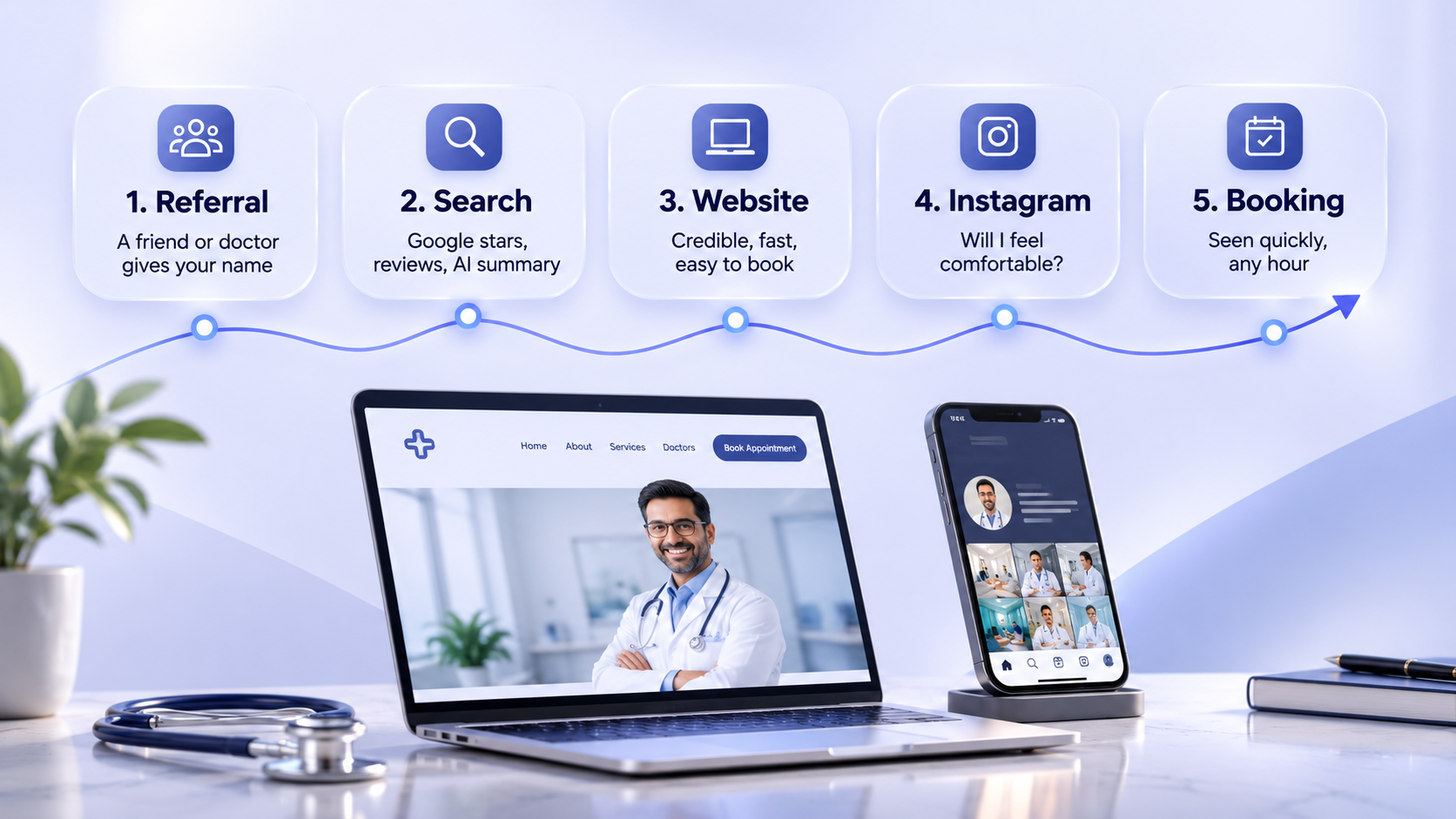
A neighbor tells a friend, “You should see Dr. Patel.” That is word of mouth, and it still matters. But what happens in the next five minutes decides whether it becomes an appointment. The friend picks up a phone, types your name into Google, checks your star rating, skims your website, taps through your Instagram and, increasingly, asks an AI assistant to summarize you.
If any of those steps disappoints, the referral dies quietly. You never see the lost patient, because they never call.
That is the real argument of this guide to doctor branding. Word of mouth is not dead, but it has moved from the finish line to the starting gun. In rater8’s 2026 Patient Choice Report, a survey of 992 U.S. adults, 75% of patients said they will not book a doctor rated below 4.0 stars, and 55% had already canceled or avoided an appointment because of online reviews. The same report found that AI tools now influence which doctor patients choose more than a referral from another doctor does, a shift Medical Economics covered in August 2026.
For California physicians the pressure is sharper. You practice in one of the largest and most diverse physician markets in the country, serving patients who compare providers on their phones the way they compare restaurants and rideshares.
This guide is written for physicians, practice owners and practice managers who want doctor branding that works before the first phone call. It covers how patients really choose a doctor in 2026, what your website and Instagram each need to do, how California’s market and advertising rules change the playbook, and a 90-day plan you can start this week.
The short version
- Patients check you online before they call, even when a friend or another doctor sent them to you.
- In doctor branding, your reviews and Google listing are the gatekeeper. Fall below 4.0 stars and most patients never see the rest.
- Your website is where a patient decides whether you are credible, available and easy to book.
- Your Instagram is where a patient decides whether they will feel comfortable with you, and it shows up when they search your name.
- California advertising law and HIPAA shape every one of these channels, so compliance has to be designed in from the start.
How patients really choose a doctor in 2026
The patient journey now starts on a screen, and it is longer and more comparative than most practices assume. Three recent data sets show the shape of it.
Most patients are shopping, even when they stay
In the rater8 survey (April 2026, 992 U.S. adults), 72% of patients had searched for or chosen a new doctor in the past 12 months. Another 59% said they were either actively looking for a new provider or open to switching if something better came along. Your current patients are not locked in. They are one frustrating visit and one bad review away from leaving.
Zocdoc’s 2025 booking data adds the behavior behind that number. The average patient viewed 21 provider profiles before booking, and psychology patients viewed 31. Patients compared credentials, read reviews and checked availability across dozens of options. Once they chose well, 84% returned to the same provider for their next appointment in that specialty. The search is exhaustive and the loyalty that follows is strong, which means the first impression is worth a great deal.
They start local, then compare
When searchers were asked what they type first, the answers were overwhelmingly local and comparative:
| First search | Share of searchers |
| “[Specialty] near me” | 55% |
| “Best” or “top-rated” [specialty] | 34% |
| A specific doctor’s name | 32% |
| Reviews for a practice | 26% |
| [Specialty] plus insurance name | 23% |
Respondents could choose up to two. Source: rater8 2026 Patient Choice Report, searchers only (n=714).
Notice the third row. One in three patients searches for a specific doctor by name. That is the moment your website, Google profile and Instagram all appear on the same results page, and it is the moment word of mouth gets verified.
Many sources shape the final decision
Patients who searched for a new doctor named the sources that most influenced their choice (up to three each):
| Source | Share of searchers |
| Friends and family | 43% |
| Insurance website or portal | 43% |
| Review sites (Healthgrades, Vitals, WebMD) | 40% |
| AI tools such as ChatGPT | 36% |
| Google search results | 34% |
| A doctor’s referral | 32% |
| Social media | 19% to 30%* |
*The report’s appendix shows 19% and one chart shows 30%, so treat social media as roughly one in five to three in ten patients.
Among patients who actually switched doctors, AI tools were the top influence at 39%. Word of mouth is still near the top of the list. It simply sits beside five other channels that you can influence directly.
The price of entry is not clinical
What keeps patients from booking is often not your medicine. Patients said the review complaints most likely to make them avoid a doctor were rude or unhelpful staff (52%), “the doctor didn’t listen” (52%), substandard care (45%), long wait times (41%) and billing problems (40%). Four of those five are experience problems that show up in your online presence long before a patient meets you.
One caution on the data: rater8 is a reputation-management company and this survey is vendor-run, so read the exact percentages as directional. The pattern, though, matches Zocdoc’s separate Censuswide survey and is consistent across three years of rater8’s own tracking.
Word of mouth is not dead, it gets verified online
The honest version of the title is this: in doctor branding, word of mouth alone is no longer enough, because it now has to pass an online test before it converts, and that test is run on your Google listing, your website and your Instagram. Think of doctor branding as a loop.
The referral-to-Google loop
Every referral, whether from a friend, a family member or another physician, sends the patient into a short sequence of silent questions. Each one is answered by a channel you either manage or neglect.
| Step | The patient’s silent question | Where they look | You control it through |
| 1. Referral | Is this person right for me? | The name they were given | Your reputation in the community |
| 2. Search | Do other people like them? | Google stars, review sites, AI summaries | Reviews, listings, review replies |
| 3. Website | Are they credible, and can I book? | Your site, on a phone | Site speed, bio pages, online booking |
| 4. Instagram | Will I feel comfortable with them? | Your profile, Reels, Stories | Content, tone, your face and voice |
| 5. Booking | How quickly can I be seen? | Booking page, phone, after-hours options | Scheduling and response time |
A failure at any step ends the journey. A strong referral cannot rescue a 3.7-star rating, and a beautiful website cannot rescue a referral that never reaches it.
Even referred patients check you
This is not new, but it has hardened. A 2019 Binary Fountain survey, reported by BenefitsPRO, found that 60% of consumers check a provider’s ratings and reviews even when another provider referred them. By 2026, rater8’s data shows 75% of patients apply a hard star-rating cutoff of 4.0 or higher before they will book at all.
Connection is what patients are really buying
Zocdoc’s national survey, run by Censuswide with 1,000 U.S. adults in November 2025, asked what matters most in choosing a doctor. The top answer was a positive personal connection with the doctor, ranked about twice as important as practical factors such as location or convenience. Zocdoc’s review analysis supports it: the phrases most distinctive to five-star reviews were things like “listens carefully” and “like family,” not references to speed or technology. You can read the full analysis in Zocdoc’s 2026 patient-choice article.
This is the strongest argument for investing in your Instagram and website. Connection is hard to prove in a directory listing. It is easy to show in a 30-second video of you explaining a procedure in plain language, in a warm bio page, in a front-desk team introduced by name, and in thoughtful replies to patient reviews. Branding is how you demonstrate, before the visit, the quality patients rank first.
What this means for your marketing budget
- Treat the referral as the lead and your online doctor branding as the closer.
- Fix the weakest step in the loop first, because the loop only converts as well as that step.
- Measure where referred patients drop off: ask every new patient how they found you and what they checked before calling.
Your website is the digital front door of your doctor branding
Your website is the one doctor branding channel where you control the message, the design and the next step. It is also the page that AI tools, Google and review sites quietly draw on when they describe you. A physician website has four jobs: prove you are credible, show you are available, make booking easy and feed accurate facts to everything else that talks about you.
1. Speed and mobile first
Most patients meet your site on a phone, so mobile speed is a doctor branding issue. Google’s own data, repeated widely in healthcare marketing, shows that about 53% of mobile visitors abandon a page that takes longer than three seconds to load (Healthcare Success summarizes this). A slow, cluttered mobile site hurts your doctor branding and tells patients the practice is behind the times before they read a word.
Doctor branding targets worth setting: a mobile PageSpeed score above 70, a tap-to-call button and a booking button visible without scrolling, text readable without zooming, and forms short enough to finish with a thumb.
2. Make booking possible at 9 p.m.
Zocdoc found that 43% of bookings on its platform happen outside traditional office hours, more than half of appointments are booked within four days of a patient deciding they need care, and 22% are booked the next day. Patients decide fast and expect confirmation to match. Zocdoc also notes that research from adjacent industries suggests online inquiry conversion drops sharply after a five-minute response delay.
For doctor branding, if your only call to action is “call during business hours,” you lose the evening decision-maker to the competitor with a booking widget. Offer online scheduling or, at minimum, a secure request form with a promised response time, plus text or chat for simple questions.
3. Give every physician a proper profile page
This is the single most overlooked doctor branding asset for independent practices. Medical Economics reported a July 2026 analysis that ran about 4,950 patient-style queries through ChatGPT across 200 randomly selected independent practices. The chatbot cited none of them. The biggest source of ChatGPT’s citations was hospital staff rosters, at 27.5%, pages that independent doctors have no equivalent for. Practice-owned websites supplied another 23%, concentrated among large, content-rich groups.
The doctor branding lesson is not that independents cannot be found. It is that you must build the pages the machines like to cite. For each physician:
- A dedicated URL with a professional photo, a plain-language bio and your actual training, certifications and hospital affiliations.
- Languages spoken, insurances accepted, conditions treated and procedures performed, each in its own readable section.
- A short video introduction, because connection is the top factor patients rank.
- A line on how to verify your license through the Medical Board of California, which reassures careful patients.
- Physician and medical-practice structured data (schema markup) so search engines and AI tools can read the facts without guessing.
4. Build content that proves expertise
Health content, including your doctor branding content, falls into Google’s higher-scrutiny category, so expertise and trust matter more than keyword volume. Write for the questions patients actually ask before they book:
- Condition and symptom pages written or reviewed by you, with your name and credentials visible.
- Procedure pages that explain what happens, recovery, risks and what to bring.
- Cost, insurance and new-patient pages that answer “will this be affordable?” because cost sets the field of doctors patients will consider, per Zocdoc’s data showing 92% of its bookings were in-network.
- A new-patient FAQ that doubles as the source for your FAQ schema.
5. Keep your facts consistent everywhere
AI answers are only as good as the data they scrape, and doctor branding depends on that data being right. The rater8 report cites a 2024 study in BMC Health Services Research that examined more than 449,000 U.S. physicians across five major insurer directories. Address information matched only 17% to 28% of the time, and phone numbers only 16% to 27%. Among patients who used AI to research providers, 66% said they had received incorrect provider information, and 60% trusted the summary without checking.
A wrong phone number or old address is a lost patient and weakens your doctor branding. Use one exact practice name, address and phone number format (your “NAP”) on your website, Google profile, insurer directories, Healthgrades, Zocdoc and every social bio. Audit them quarterly.
6. Website checklist
- Loads in under three seconds on a mid-range phone over 4G.
- Tap-to-call and booking buttons above the fold on every page.
- One page per physician and one page per major service.
- Real photos of you, your team and your office for doctor branding, never generic stock.
- Visible credentials, license information and insurance list.
- Review ratings shown from a real platform, with a link to read more.
- HIPAA-conscious forms and a clear privacy policy.
- Accessible design: readable contrast, alt text and keyboard navigation.
- Structured data for the practice, each physician and the FAQ.
Why Instagram builds doctor branding trust before the appointment
Be clear-eyed about what Instagram does for doctor branding. In the data above, social media ranks below reviews, AI tools, Google and insurer sites as the thing that decides a patient’s final choice. If you expect Instagram to replace reviews or a website, it will disappoint you.
What it does better than any other channel is make a stranger feel they know you, which is the heart of doctor branding on social media. That matters because personal connection is the top factor patients name. It also matters for a plain mechanical reason: one in three patients searches for a doctor by name, and a professional, active Instagram profile is part of what appears when they do.
The audience is there
Pew Research Center’s 2025 survey, as summarized by SocialPilot, found 50% of U.S. adults use Instagram. Use is highest among younger adults: about 80% of 18 to 29-year-olds, 62% of 30 to 49-year-olds, 40% of 50 to 64-year-olds and 19% of those 65 and older. If your practice serves parents, young professionals, women’s health, dermatology, aesthetics, dentistry, orthopedics, mental health or pediatrics, a large share of your patients is already scrolling.
What the research says about doctors on social media
A 2024 study in Frontiers in Public Health surveyed 35 doctors and 322 patients in China. It found that doctors who posted professional knowledge content were associated with better patient adherence and treatment outcomes, while doctors who posted personal life content were associated with lower adherence. The sample is small and from a different health system, so treat it as a signal rather than a rule. The practical takeaway is consistent with what patients say they want: lead with expertise and warmth, and keep personal posts limited and professional. (Study abstract)
Five content pillars for doctor branding on Instagram
- Teach. Short answers to the questions patients ask most, such as “When should I worry about this mole?” or “What really happens in a colonoscopy?” Explain in plain language and state clearly that it is general education, not individual medical advice.
- Show the doctor. A 20 to 40 second introduction, your approach to care, why you chose your specialty. Patients who feel they have met you arrive less anxious.
- Demystify the visit. Walk through the office, what the first appointment is like, how billing and insurance work. Anxiety about the unknown is a real barrier to booking.
- Introduce the team. Rude or unhelpful staff is the most-cited review deal-breaker, so show the people patients will actually meet, with names and roles.
- Be local. Community events, neighborhood health tips, seasonal topics for your city. This reinforces your local relevance for “near me” searches.
Formats that earn attention
Video gets the reach for doctor branding. Socialinsider benchmarks, as summarized by SocialPilot, found Reels reach about 2.25 times more users than single-image posts. At the same time, Instagram engagement per post fell about 24% across brands in 2025, and carousels still edged out Reels on engagement in at least one 2026 roundup. The sensible mix for a practice: Reels to be discovered, carousels for education people save and share, and Stories to keep current patients and followers close.
Set up the profile as a conversion page
Your Instagram profile is a doctor branding landing page. Make every element do work:
- Name and handle: your professional name plus specialty and city, so it matches your website and Google listing (for example, “Dr. Maya Patel | Dermatologist | San Diego”).
- Bio: who you help, what you treat, where you are, one differentiator and a clear call to action.
- Link in bio: straight to online booking, not your homepage.
- Contact buttons: call, directions and email turned on.
- Highlights: “Meet Dr.”, “First visit”, “Services”, “Insurance”, “Patient questions”, “Location”.
- Pinned posts: your best introduction Reel, a services carousel and an FAQ carousel.
- Consistent look: one font, one color palette and similar lighting so the feed looks organized, which signals order and care.
A sustainable weekly rhythm
Consistency beats volume in doctor branding. A solo physician with a part-time coordinator can run this on about two to three hours a week:
| Day | Content | Goal |
| Monday | Educational Reel answering one patient question | Reach new people |
| Wednesday | Carousel: myths and facts, or a procedure explained | Saves and shares |
| Friday | Stories: team moment, office view, a Q&A sticker | Stay familiar |
| Weekly | Reply to every comment and direct message within 24 hours | Trust and bookings |
Remember the privacy line
In doctor branding, never show a patient, a chart, a screen or even an identifiable background without written authorization. Before-and-after content, testimonials and replies to reviews all carry specific rules in California. The compliance section below covers them in detail, and it should shape your content plan from day one.
The California market for doctor branding: crowded, multilingual and digital-first
California is not a typical U.S. physician market, and a doctor branding plan built for “the average American patient” will under-perform here. Three features of the state change the playbook.
1. Competition has grown faster than the population
The California Health Care Foundation’s 2025 physician almanac reports that the number of active physicians in the state rose 33% between 2006 and 2022, while the population grew 8%. The CHCF also notes that counting physicians is not clear-cut, because many with active licenses do not provide patient care in the state. Even so, in dense metros patients have a deep bench of choices within a short drive, which is why they compare so aggressively and why a strong brand is a price of entry rather than a luxury.
And competition is not only other solo doctors. Hospital systems and large groups are advantaged in AI answers, as shown earlier, so an independent California practice has to out-execute them on structured, specific, trustworthy content.
2. Your patients speak many languages
A UCLA Latino Policy and Politics Initiative brief, drawing on 2018 state data, reported that nearly 44% of Californians speak a language other than English at home and about 19% can be categorized as limited English proficient. The same brief found a sharp mismatch in supply: Spanish-speaking physicians numbered about 62 per 100,000 Spanish-speaking residents, versus roughly 344 per 100,000 English-only residents, using 2015 Census figures. Those are older numbers and the picture has likely shifted, but the direction is clear. (UCLA brief)
For a practice, language is both a service and a doctor branding asset. If you or your team speak Spanish, Mandarin, Cantonese, Korean, Vietnamese, Tagalog, Farsi, Armenian, Hindi or Punjabi, that should be the loudest line on your site, Google profile and Instagram bio, not a footnote. Practical steps:
- Add languages spoken to every physician’s profile page and structured data to strengthen doctor branding.
- Create translated versions of your top service and new-patient pages, written by a native speaker rather than machine-translated.
- Record short Reels or captioned videos in the languages your team speaks.
- Mention language support in your Google Business Profile description and in review replies.
- Ask satisfied patients to write reviews in their own language. Google and AI tools can read them, and prospective patients in that community trust them.
3. Patients are tech-forward and time-poor
California patients, especially in coastal and urban areas, are used to booking everything from a phone. Zocdoc’s data shows that most care is still in person (93% of appointments booked through Zocdoc in 2025, outside mental health), so your brand’s job is to get them confidently to the exam room, not replace it with telehealth. Telehealth is a useful option for follow-ups and access, and worth featuring where you offer it, but the booking experience, the front-desk experience and your visible warmth decide whether a new patient arrives.
Where California independents can win
Big systems are strong on rosters and volume, but doctor branding rewards personality. You are strong on being a real person with a clear point of view. Win with named physicians, specific specialties, patient-friendly explanations, visible languages, fast booking and a review profile that proves how patients actually feel. Those are exactly the signals patients and AI tools reward.
Doctor branding in Silicon Valley, San Francisco, Los Angeles, San Diego and beyond
Patients choose care close to home, so your doctor branding has to read as local in every channel. Here is how doctor branding shifts across California’s major regions. These are positioning observations drawn from the general character of each market and from how local agencies describe them, not hard statistics, so test each idea against your own patient data.
Doctor branding in Silicon Valley and San Jose
Doctor branding for Silicon Valley patients means speaking to engineers, founders, researchers and their families, people accustomed to products that work flawlessly on a phone. A physician website in San Jose, Palo Alto, Mountain View, Sunnyvale or Santa Clara that loads slowly or buries its booking button looks dated. The region also has large Chinese, Indian, Vietnamese, Filipino and Latino communities, so language is a differentiator.
- Win doctor branding on speed, online booking with real availability and a clean mobile experience.
- Use Instagram and short video to explain the evidence behind your approach in plain language. This audience rewards substance.
- Feature research credentials, training and hospital affiliations on each physician page.
- Publish key pages in Mandarin, Hindi, Vietnamese, Spanish or Tagalog if your team can serve those patients.
Doctor branding in San Francisco and the East Bay
For doctor branding, San Francisco, Oakland and Berkeley are neighborhood-driven markets where patients search by district and expect transparency on insurance, fees and credentials. Privacy-conscious patients also notice how you handle their data.
- Build neighborhood-aware pages and Google Business Profile descriptions for areas such as SoMa, Pacific Heights, Noe Valley or Oakland.
- State insurance and cost information clearly.
- Show a human, thoughtful voice on Instagram, because Bay Area patients compare options carefully before booking.
Doctor branding in Los Angeles
Los Angeles is the most competitive and image-aware market in the state for doctor branding, and Instagram matters most here for specialties such as dermatology, plastic surgery, dentistry, wellness and aesthetics. Patients search by neighborhood and commute, so Beverly Hills, Santa Monica, Encino, Sherman Oaks, Pasadena and Glendale each behave like their own market.
- Create location-specific pages and Google profiles for each office.
- Follow California’s before-and-after, model-labeling and testimonial rules strictly, because visual content is where violations happen.
- Serve LA’s linguistic diversity, including Spanish, Korean, Armenian, Farsi and Mandarin, in both your site and your video content.
Doctor branding in San Diego
Doctor branding in San Diego has to serve a mix of military families, biotech and university professionals, active coastal communities and a bilingual border region. Patients value convenience, clarity on coverage and a friendly, approachable tone.
- State accepted insurance plans clearly, including military coverage such as TRICARE if you accept it.
- Publish bilingual English and Spanish content.
- For sports medicine, orthopedics, wellness and family care, use Reels that show your approach in everyday terms, tied to neighborhoods such as La Jolla, Carlsbad and Encinitas.
Doctor branding in Orange County and Irvine
Orange County has affluent suburban families, a large and varied Asian-American community and strong demand for dental, pediatric, women’s health and aesthetic care. Reviews carry heavy weight, and families often research on behalf of parents and children.
- Keep a 4.5-star-plus Google profile with a steady flow of recent reviews, because reviews are the foundation of doctor branding.
- Create family-oriented educational content for parents.
- Offer Vietnamese, Korean, Mandarin and Spanish support where you can.
Doctor branding in Sacramento and the Central Valley
Sacramento, Roseville, Folsom, Elk Grove and the Central Valley have fast-growing suburbs and strong demand for access to care. Availability is a doctor branding message in itself.
- Highlight new-patient openings, same-week appointments and clear insurance and Medi-Cal acceptance if applicable.
- Reach local language communities, such as Spanish, Punjabi and Hmong speakers, with translated pages and captioned video.
- Partner with community organizations, schools and employers to earn local mentions and trust.
How to make your doctor branding feel local, wherever you practice
- Put your city or neighborhood in your title tags, H1s and Google Business Profile description.
- Use real photos of your building, your team and local landmarks, never generic stock.
- Set a consistent name, address and phone number across every listing.
- Mention the neighborhoods you serve in your Instagram bio and highlights.
- Earn local links and mentions from medical societies, chambers of commerce, community groups and local news.
- Reply to reviews in a way that reflects your community and your languages, without ever revealing patient details.
Local SEO, Google and reviews: the engine behind your doctor branding
Doctor branding that nobody can find or trust does not book appointments. This section is the plumbing that turns a good website and Instagram into actual new patients.
Search is now a three-layer game
Your doctor branding meets patients in three places on the same Google results page, and they trust them differently. In rater8’s survey, the section of Google that patients trusted most was the AI Overview at 37%, ahead of organic links at 20%, the local map pack at 13% and sponsored ads at 7%. rater8 also cites BrightEdge research showing that 89% of Google searches containing a healthcare keyword now trigger an AI Overview.
In plain terms for doctor branding: ads are the channel patients trust least, and AI summaries are the one they trust most. Practices that over-spend on ads and under-invest in the content, listings and reviews that AI summaries draw from are backwards.
Your Google Business Profile is the most valuable free asset you own
55% of searchers start with “[specialty] near me,” and that search is answered mostly by Google’s map listings. For doctor branding, complete and maintain a profile for the practice, and where relevant for each physician:
- Choose accurate primary and secondary categories (for example “Dermatologist” plus “Skin care clinic”).
- Write a description that includes your specialty, neighborhood, languages and what makes you different.
- Keep hours, phone, address, website and booking link exact, including holiday hours.
- Add the services you provide, insurance accepted and attributes such as wheelchair access and languages.
- Upload real photos: the building and entrance, parking, waiting room, exam rooms and team. Add new ones monthly.
- Post updates and short videos regularly.
- Answer the Q&A section yourself so nobody else does it wrong.
Then mirror the same name, address and phone number everywhere else your doctor branding appears: Healthgrades, Vitals, WebMD, Zocdoc, insurer directories, Apple Maps, Yelp and your social bios.
Win the star rating
The 4.0-star cliff is the most important number in this guide to doctor branding. rater8’s survey found that 75% of patients require at least 4.0 stars and 44% require at least 4.5. For comparison, BrightLocal’s 2026 survey of consumers across all kinds of businesses put those thresholds at 68% and 31%, so healthcare is judged more harshly than restaurants or salons.
The good news: patients are willing to help. 68% said they would be likely to leave a review if their doctor asked, and only 12% said they would not. The share who rarely or never write reviews has fallen from 56% to 42% in a year. Scott Bartnick of Otter Public Relations, quoted by Medical Economics, suggests a practice with a thin review base aim for 15 to 20 recent five-star reviews as a credibility floor, then build outward.
A simple review system for doctor branding:
- Ask in person at checkout: “If you were happy with your visit, would you share a quick review? It really helps other patients find us.”
- Send a text or email within 24 hours with a direct link to your Google review page.
- Place a QR code at the front desk and on after-visit summaries.
- Ask every patient, not only the ones you think are happy. Selecting only likely-positive patients to ask is a practice Google’s policies prohibit.
- Never offer payment, discounts or gifts for reviews. Federal and platform rules on incentivized and fake reviews are strict, and California advertising law adds its own exposure. Confirm current rules with counsel.
Reply to every review
The single biggest year-over-year change in the rater8 survey was reply behavior. 66% of patients now say that seeing a provider respond to online reviews influences their trust, up from 42% the year before. Replies are also read by AI tools that summarize your practice.
Some doctor branding ground rules for replies:
- Reply within 48 hours, in a voice that sounds like a person, not a template. Medical Economics quotes Bartnick advising against automated, canned replies.
- Thank positive reviewers generically, without naming them in a way that confirms they were patients, and mention something real about your approach or team.
- Never confirm that someone is a patient, mention treatment or reveal any detail of care in a reply. Under HIPAA, even acknowledging that a reviewer was your patient can be a disclosure. Move specifics offline.
- For negative reviews: acknowledge the experience in general terms, state your commitment to listening, and invite them to contact the practice manager. Prospective patients read the tone of the reply as much as the complaint.
Example reply to a complaint about waiting time:
“Thank you for taking the time to share this. We take wait times seriously, and we are sorry that your experience did not meet the standard we aim for. Because of patient privacy we cannot discuss any individual visit here, but we would welcome the chance to hear more. Please contact our practice manager at [phone or email] so we can look into it.”
Fix the cause, not only the symptom
Reviews are also a diagnostic tool for doctor branding. The top deal-breakers patients cite are rude staff, not feeling listened to, long waits and billing confusion. If those themes appear in your reviews, retrain the front desk, adjust scheduling templates, publish clear billing information and coach your clinical team on listening. A five-star profile is easier to build in a practice that deserves one.
Compliance guardrails for doctor branding in California
Strong doctor branding and strict rules are compatible, but only if you design for both. California is one of the most detailed advertising regimes in the country, and HIPAA applies on top. This section summarizes the rules most likely to affect your website, Instagram and reviews. It is general information, not legal advice, and you should have your advertising reviewed by a California healthcare attorney before launch.
California advertising law: Business and Professions Code section 651
Section 651 covers physicians and other licensed healing-arts professionals. It prohibits any public communication, expressly including the internet, that contains a false, fraudulent, misleading or deceptive statement, claim or image. According to Bay Legal’s 2026 summary of the statute, the main points are:
- Superiority claims such as “best doctor” or “most advanced” must be relevant to the service and backed by objective scientific evidence.
- Scientific claims must be supported by reliable, peer-reviewed, published studies.
- Price advertising must be exact. Phrases like “as low as,” “and up” or “lowest prices” are not allowed, and comparative claims must rest on verifiable data.
- Models: any photo of someone other than an actual patient who underwent the advertised procedure must be clearly labeled as a model.
- Before-and-after photos of actual patients must state the procedures performed, be presented comparably (no flattering lighting or poses) and carry a statement that the same results may not occur for all patients.
- Altered images that do not accurately depict results are treated as misleading.
- Testimonials and endorsements are unlawful if they are likely to mislead because material facts, such as a paid relationship, are not disclosed.
- Board certification: you may not say you are board certified unless the board meets the statute’s criteria, such as an American Board of Medical Specialties member board.
The consequences are real
Per the same summary, a violation is a misdemeanor, is grounds for license discipline, can bring an administrative fine of up to $10,000 per event for knowing and intentional violations, and allows the Attorney General to seek an injunction and recover enforcement costs. The figures are statutory amounts as stated in that source, so confirm the current numbers with counsel.
Paying for referrals versus paying for publicity
These are governed by different sections and are easy to confuse:
- Referral payments are generally unlawful under section 650. Paying anyone for referring patients can be a criminal offense, and a payment-per-patient influencer deal can drift into this territory.
- Paid publicity is allowed with disclosure under section 651. If you compensate an influencer or publication, the fact of compensation must be made known in the content itself.
Titles and practice names
Section 2054 restricts use of “doctor,” “physician,” “Dr.” and “M.D.” or “D.O.” to people entitled to them and was amended effective January 1, 2025, so recheck staff bio pages. If you practice under a name other than your own, a fictitious-name permit may be required under section 2415.
HIPAA and social media
Patient information cannot be used in marketing without a signed HIPAA authorization. That covers names, photos, videos, testimonials, success stories and anything that could identify a patient, including backgrounds in office videos. In 2025 the HHS Office for Civil Rights fined a Delaware nursing home $182,000 after it posted photos and names of about 150 residents in a “success stories” social media campaign, according to reporting by BankInfoSecurity.
Keep these doctor branding habits:
- Get written authorization that names the platforms and duration before any patient content goes public.
- Never reply to a review in a way that confirms a person was your patient.
- Review every photo and video for charts, screens, names, faces and background details before posting.
- Train all staff, including whoever runs your Instagram, because HIPAA applies to personal accounts too.
- Ask counsel about analytics, tracking pixels and forms on your website, which can unintentionally send patient information to third parties. Medical Economics published a practical checklist on this in October 2026.
Quick reference
| Do | Do not |
| Educate with general, accurate information | Give individual medical advice in comments or DMs |
| Label model photos as models | Use stock photos implying real patient results |
| Use authorized, comparable before-and-after photos with required statements | Retouch, filter or selectively light results |
| Disclose paid partnerships in the content | Pay per patient referred |
| Say “board certified” only when the board qualifies | Claim to be “the best” without substantiation |
| Reply to reviews generically and move details offline | Confirm someone’s visit, treatment or diagnosis publicly |
A 90-day doctor branding plan
You do not need to do all your doctor branding at once. Sequence matters: fix what patients check first, then build what makes them like you, then scale what works. This plan assumes a small to mid-size practice with one person responsible for marketing part time.
| Weeks | Focus | Key actions | Done when |
| 1 to 2 | Audit and foundations | Test your doctor branding. Search your own name and “[specialty] near me” in Google, on your phone, and in ChatGPT or another AI assistant; record star ratings and any wrong facts; claim and verify your Google Business Profile and major directories; standardize your name, address and phone number | You have a one-page baseline report and every listing shows identical, correct details |
| 3 to 4 | Website quick wins | Fix mobile speed; add tap-to-call and a booking button above the fold; build or update a page for each physician and your top five services; add languages spoken and insurance accepted | Mobile load time is under three seconds and each physician has a complete page |
| 5 to 6 | Review engine | Write your review-request script; add QR codes and follow-up texts; reply to every existing review; train front-desk staff on the process and on HIPAA-safe replies | Review requests are sent after every visit and no review is older than 48 hours without a reply |
| 7 to 8 | Instagram launch | Set up the profile, bio, highlights and link to booking; film an introduction Reel and a team video (with consent); create 10 to 12 educational posts in batch; schedule the first four weeks | Profile is complete and the first month of content is scheduled |
| 9 to 10 | Authority content | Publish two condition or procedure pages and one FAQ page with structured data; add a Spanish or other community-language page if relevant; seek mentions on local health or community sites | New pages are indexed and linked from your main navigation |
| 11 to 12 | Measure and adjust | Compare against your baseline: stars, review count, calls, bookings, profile visits, branded searches; ask every new patient how they found you; drop what is not working | A simple dashboard shows trend lines and you have a plan for the next quarter |
Who should do what
- You (the physician): appear on camera for 30 to 60 minutes a month, approve clinical accuracy, and set the tone.
- Practice manager: owns the review system, listings accuracy and response times.
- Front-desk team: asks for reviews, answers messages quickly, and uses approved scripts.
- Marketing partner: builds and maintains the website, content system, search presence and reporting, so the rest of the team does not have to learn all of it.
A realistic budget view
Doctor branding budgets vary widely by specialty, market and how much work you do in-house. Think in three buckets rather than a single number: a one-time foundation (website fixes, listings, profile setup, branding), a monthly engine (content, reviews, local SEO, light paid support) and your own time. Compare the total to what one new patient is worth to you, which the metrics section below shows how to calculate.
Seven doctor branding mistakes that cost practices patients
- Treating word of mouth as the whole strategy. Referrals start the journey but they do not finish it. Patients verify you on Google, your website and Instagram, and a weak result there loses the referral without you ever knowing.
- Ignoring the star rating and the replies. With 75% of patients requiring 4.0 stars or more and 66% saying review replies affect trust, an unmanaged profile is a silent filter that removes you from consideration.
- Running a slow, dated website with no easy way to book. A mobile site that takes more than a few seconds to load, hides the phone number or only offers a business-hours phone call loses the 9 p.m. decision-maker.
- Using Instagram as a billboard. Stock photos, ads and an absent face do not build connection. Patients rank personal connection first, so show the doctor and the team, and teach something useful.
- Letting your information drift. Different phone numbers, old addresses and missing insurers across directories confuse patients and AI tools alike. Audit your listings quarterly.
- Posting patient content without authorization. Photos, stories, review replies that confirm a patient relationship and careless before-and-after posts create HIPAA exposure and California advertising violations. Build an approval step before anything goes public.
- Never measuring. If you do not ask new patients how they found you and what they checked first, you cannot tell which channel is working. Track it from week one.
A quick self-test
Search your own name and “[your specialty] near me” on your phone tonight. Then ask an AI assistant who the best doctors for your specialty are in your city. If the results show a rating below 4.5, outdated details, a slow site or nothing from you at all, you have found your first priority.
Measuring doctor branding results: the metrics that matter
Doctor branding feels intangible until you attach numbers to it. Track a small set of metrics monthly and tie them to what a new patient is worth.
The scorecard
| Metric | Why it matters | Where to find it |
| Google star rating and review count | The 4.0 and 4.5 thresholds decide whether you are considered | Google Business Profile, review platforms |
| Review response time and rate | 66% of patients say replies influence trust | Your review dashboard |
| Profile actions: calls, direction requests, bookings | The direct result of local visibility | Google Business Profile insights |
| Branded searches (your name and practice name) | A sign your brand is spreading | Google Search Console |
| Website mobile speed and conversion rate | Shows whether visitors become requests | PageSpeed Insights, analytics |
| Online booking and form requests | Counts the leads you create | Booking system, analytics |
| Instagram reach, saves, profile visits and link clicks | Measures trust and interest, not vanity likes | Instagram Insights |
| New patients by source | The most important number | A required “How did you hear about us?” question |
To measure doctor branding, offer these answer options in your intake form and front-desk script: friend or family, another doctor, Google search, Google Maps, Instagram, an AI assistant, an insurance directory, a review site, other. Include a prompt for what they checked before calling, because many patients will say “a friend” and omit the three online steps that actually closed the decision.
Cost per new patient and what a patient is worth
The core doctor branding formulas are simple:
\text{Patient acquisition cost} = \frac{\text{Total marketing cost}}{\text{New patients acquired}}
\text{Lifetime value} = \text{Revenue per visit} \times \text{Visits per year} \times \text{Years retained}
Illustrative example only (use your own numbers). A practice spends $4,000 a month on its website, content, review tools and local SEO and gains 16 new patients attributable to that effort. Acquisition cost is $250 per patient. If a typical patient is worth $1,800 over their time with the practice, the lifetime value to acquisition cost ratio is 7.2 to 1.
For context, Zocdoc has published benchmarks that put the average first-year value of a new patient at roughly $538 for smaller medical groups and $1,395 for health systems, in an undated article whose figures you should check for currency. A common rule of thumb in practice-marketing calculators is to aim for at least 3 dollars of lifetime value for every dollar of acquisition cost, though the right ratio depends on your specialty, payer mix and capacity. Aesthetic and self-pay practices often justify higher acquisition costs than insurance-driven primary care.
Retention counts too
rater8 found that 59% of patients are either actively looking for a new provider or open to switching. Strong doctor branding lowers acquisition cost and also raises retention, because patients who see a responsive, visibly caring practice online have fewer reasons to leave. Track return rates and the share of patients who book their follow-up before leaving.
Review the numbers every month
A 30-minute monthly doctor branding review is enough: look at the scorecard, find the weakest step in the referral-to-Google loop, assign one fix and check it next month. Small, steady improvements compound across Google, your website and Instagram at the same time.
Frequently asked questions about doctor branding
What is doctor branding?
Doctor branding is the deliberate way a physician or practice presents who they are, how they care for patients and why they are trustworthy, across their website, Google listing, reviews, Instagram and in-person experience. Good branding makes patients feel they know you before they book.
Is word of mouth still important for doctors?
Yes, even in doctor branding. In rater8’s 2026 survey, friends and family tied for the most influential source of new-doctor choices at 43%. But patients now verify referrals online, and 75% will not book a doctor rated below 4.0 stars, so word of mouth works best when your website, reviews and Instagram back it up.
Why does Instagram matter for a medical practice?
Instagram lets patients see and hear you before the visit. In doctor branding, that early familiarity is hard to buy any other way. Personal connection is the top factor patients name when choosing a doctor, and about half of U.S. adults use Instagram. It builds trust and familiarity, though reviews, Google and your website still do most of the final convincing.
Does my practice need a website if I get most patients by referral?
Yes. Referred patients still look you up, and website quality is central to doctor branding. A slow, outdated or unclear site can end the referral. Your website also supplies the facts that Google and AI tools use to describe you, and gives patients a way to book after hours.
What star rating and how many reviews do doctors need?
Aim for at least 4.5 stars with a steady flow of recent reviews. In rater8’s survey, 75% of patients required 4.0 or higher and 44% required 4.5 or higher. Reply to every review, because 66% of patients say responses affect their trust.
Can California doctors post patient photos or before-and-after images?
In doctor branding, yes, but only with written patient authorization under HIPAA and in compliance with California Business and Professions Code section 651, which requires labeling of models, a statement of procedures performed, comparable presentation and a statement that results may vary. Speak with a California healthcare attorney before posting.
Does doctor branding work differently in Silicon Valley, Los Angeles, San Francisco and San Diego?
The doctor branding fundamentals are the same, but the emphasis changes. Silicon Valley patients expect fast mobile booking and evidence-based content. Los Angeles rewards strong visual branding and neighborhood pages. San Francisco patients value transparency and privacy. San Diego often calls for clear insurance information and bilingual content.
How long does doctor branding take to show results?
Fixes to listings, reviews and booking can improve calls and bookings within weeks. Search rankings and an Instagram audience usually take several months of consistent work. Plan on a three to six month window before judging results, and track new patients by source.
Should I hire a marketing agency for my practice?
If you have the time and skills, you can handle the basics of doctor branding in-house using the 90-day plan above. Many physicians choose a partner who understands healthcare advertising rules, builds the website and content system and reports on new patients, so the practice can focus on care.
Your doctor branding is working before you walk into the room
Patients in San Jose, San Francisco, Los Angeles, San Diego and every California community now meet your doctor branding on a screen first. They arrive with a referral in hand, then check your stars, your website and your Instagram, and increasingly ask an AI assistant to sum you up. Word of mouth opens the door. Your online presence decides whether they walk through it.
The good news is that every step is within your control. Fix your listings and reply to reviews. Build a fast website with real physician pages and easy booking. Show your face and your team on Instagram, teaching and welcoming rather than advertising. Stay inside California’s advertising rules and HIPAA. Measure new patients by source and improve one step each month.
Want help building this for your practice?
Infinoq helps physicians and clinics build doctor branding that earns trust online, from website design and Instagram content to the review and local search systems behind them. If you would like an honest look at where your referral-to-booking loop is leaking, get in touch with our team for a brand and website review.
This article is general information, not legal, medical or financial advice. California advertising and privacy rules change, so have a California healthcare attorney review your marketing before you publish.
Sources
Pages opened and read in full:
- rater8, 2026 Patient Choice Report
- Medical Economics, “Patients now shop for doctors like consumers, and the bar just got higher” (Aug. 13, 2026)
- Zocdoc, “What patients actually look for when choosing a doctor in 2026”
- Bay Legal, “Healthcare Advertising Rules California Providers Face”
Additional references (read as search-result excerpts):
- BenefitsPRO, Binary Fountain 2019 consumer survey
- SocialPilot summary of Pew Research Center 2025 Instagram data
- Frontiers in Public Health, 2024, doctors’ social media behavior and patient adherence
- California Health Care Foundation, California Physicians 2025 almanac
- UCLA Latino Policy and Politics Initiative, AltaMed policy brief
- BankInfoSecurity, nursing home fined $182K for posting patient photos
- Healthcare Success, website load-time data
- Zocdoc, new patient value benchmarks
Survey caveats: the rater8 and Zocdoc figures come from company-run surveys (rater8 n=992, Zocdoc and Censuswide n=1,000), so treat percentages as directional. Legal figures are as stated in the cited sources and should be confirmed with counsel.