Google’s AI Now Answers 80% of Brand Searches. Here’s How to Make Sure It Says the Right Things About Yours
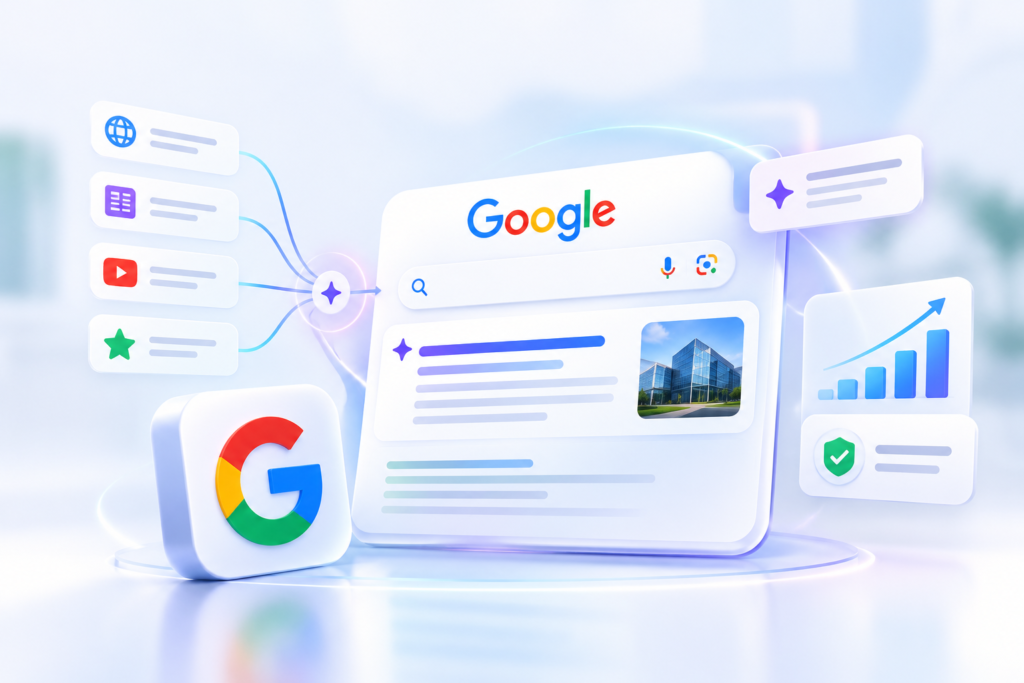
Before you read on, try this. Open a private browser window and search your company’s name on Google. There’s a good chance the first thing you see isn’t your website. It’s an AI-written summary of your business.
That is new, and it happened fast. At the start of September 2026, Google showed AI Overviews on about 26% of the branded searches DemandSphere tracks. On September 27 that number peaked at 90.48%, and it stayed above 80% in the days after (Search Engine Land). A separate test by Nectiv found AI Overviews for 93 of 100 enterprise brands.
Google isn’t the only place this is happening. OpenAI says ChatGPT reaches 1.2 billion people a week, and it is now adding visual ads and measurement tools.
So the question for every business has changed. It’s no longer just “Do we rank?” It’s “When AI describes us, is it right, and does it send people to us?”
That work has a name: GEO, or generative engine optimization. There’s a lot of noisy GEO advice out there. This guide sticks to what Google itself says works, what it says you can ignore, and a 30-minute audit you can run today.
Quick answer: To get cited in Google AI Overviews, your pages must be indexed and eligible to show a snippet. Then publish original, expert content, keep your business facts consistent everywhere, and track results in Search Console’s Generative AI performance report. Google says llms.txt files, “chunking” content and fake mentions don’t help.
What Changed in the Last 30 Days
Four shifts landed between late September and early October 2026:
AI answers now sit on top of brand searches. Neither study measured clicks yet, so nobody knows the traffic impact. But the first impression of your brand is now written by AI.
Google tightened its line on AI-written content. Its help page now says it is critical to fact-check and review all AI-generated content before publishing. That includes titles, meta descriptions, structured data and image alt text (Google Search Central).
AI shopping answers favor big names. In one study run for Lightspeed Commerce, ChatGPT and Gemini (without web search) named large chains 63–70% of the time and small independents about 10%. Adding the word “independent” to a prompt more than doubled small-store mentions.
ChatGPT is becoming an ad channel. OpenAI is testing visual ads with a group of US advertisers, along with new attribution partners.
The common thread: machines now decide which businesses get named. The ones that get named have clear, correct, consistent facts.
Is GEO Different From SEO? Google’s Answer
According to Google, no. Its guide to optimizing for generative AI search says AI Overviews and AI Mode run on the same core ranking and quality systems as regular Search. From Google’s point of view, optimizing for AI search is still SEO.
Two mechanics explain why:
Grounding (RAG). The AI pulls fresh pages from Google’s index, then writes its answer from them and links to them. If you aren’t indexed, you can’t be cited.
Query fan-out. For one question, the AI quietly runs several related searches. A search for “best digital agency for a startup” might fan out to pricing, reviews and case studies. Pages that answer those follow-up questions get pulled in.
5 GEO “Hacks” Google Says You Can Skip
This is the part most GEO sellers won’t tell you. Google’s own guide lists these as things you can ignore for Google Search:
llms.txt files. Google Search doesn’t use them. They don’t help or hurt.
“Chunking” content into tiny pieces. Google can find the relevant part of a long page on its own.
Rewriting pages “for AI.” AI understands synonyms. You don’t need every long-tail variation.
Buying or faking mentions. Spam systems filter them, and AI features depend on those systems.
Special AI schema. There is none. Structured data still helps rich results, but it isn’t required for AI features.
Google also warns that no third-party tool has access to its internal ranking or AI systems. Be careful with anyone who promises guaranteed AI citations.
What Actually Gets You Cited: 7 Steps
Be eligible first. A page must be indexed and allowed to show a snippet. Verify your site in Google Search Console and check that your key pages are indexed.
Publish content only you can write. Google contrasts generic “7 tips” posts with first-hand pieces about what you actually did and learned. Share real numbers, client results, mistakes and opinions.
Fix your facts at the source. AI repeats what it finds. Make your name, address, phone, hours and services identical on your website, Google Business Profile, LinkedIn and directories.
Say plainly who you are and who you serve. If you’re independent, founder-led, or focused on a city or industry, write those exact words on your About page and profile.
Put a human on every fact. Use AI to draft and research, then have a named person check every number, name, date and price before publishing.
Add real images and video. AI features can show images and videos from your pages, which gives you more ways to appear than a text link.
Measure it. Search Console’s Generative AI performance report shows how your content performs in AI features. Check it monthly.
We Ran This on Ourselves
We’re a young agency, founded in 2024. When we searched our own name, lookalike brands with similar names showed up before us. That’s the exact problem this guide describes: if AI and search engines can’t tell who you are, they’ll describe someone else.
So we’re doing the same work we recommend. We’re tightening our site structure, writing unique page titles and descriptions, building our Google Business Profile, and publishing first-hand content like this. We’ll share the before-and-after in a follow-up post.
Your 30-Minute AI Visibility Audit
Search your brand name on Google in a private window. Read the AI Overview like a stranger would.
Ask ChatGPT and Gemini: “What is [your brand]?” and “Who are the best [your service] providers in [your city]?”
List every wrong or missing fact: services, location, phone, founding year, prices.
Fix each one where AI likely found it: your website, Google Business Profile, or a directory listing.
Search site:yourdomain.com to check how many of your pages Google has indexed.
Open Search Console and check the Generative AI performance report.
Pick one service page and add something only you know: a real result, a process photo, or a short video.
Set a reminder to repeat this audit next month.
Frequently Asked Questions
What is an AI Overview?
It’s the AI-written summary Google shows above regular results. It answers the search directly and links to the web pages it drew from.
What is GEO (generative engine optimization)?
GEO is the work of making your business visible and accurately described in AI answers from Google, ChatGPT and Gemini. Google says that for its own search, this is still SEO, built on the same ranking systems.
Do I need an llms.txt file to show up in AI search?
Not for Google. Google says Google Search ignores llms.txt files. Creating one won’t hurt, but it won’t help your Google visibility either.
Can I use AI to write my website content?
Yes, but Google now says it’s critical to manually fact-check and review all AI-generated content before publishing. Have a real person verify every fact and sign off on the page.
How do I know if my business appears in AI Overviews?
Search your brand and key services in a private window, and check the Generative AI performance report in Google Search Console. Repeat it monthly, because AI answers change.
Want to Know What AI Says About Your Brand?
We’ll run this audit for you, covering Google AI Overviews, ChatGPT, Gemini and your Google Business Profile. You’ll get a one-page list of what AI gets wrong about your business and how to fix it.
- By admin
- No Comments