

At a Saturday open home, a neighbour asks what the townhouse across the road sold for. They own a similar place and might sell next spring. What could they find on your website on Sunday morning that would make them want to continue that conversation?
This real estate marketing Australia guide starts with that homeowner. It shows how to build a suburb-specific campaign, follow up on an enquiry and measure the appraisals you actually attend. Copy the lead funnel template below and adapt it to one suburb you know well.
Table of Contents
1. Start with a question only a local agent can answer
Look through your last ten seller conversations. Which question came up twice? A unit owner may want to know why two flats in the same block sold for different prices. A family preparing for an auction may be wondering which repairs to finish before photography. Choose one question for your first campaign.
Write a short answer using evidence you can share. For the unit owner, compare two verified sales and describe differences in floor area, parking, aspect or condition. Give the sale dates and explain the limits of the comparison. A suburb median alone tells the owner very little about a particular flat.
2. Give local searchers a useful place to land
Build one page for the suburb and property type you can cover in detail. A heading such as “Selling a townhouse in Preston, VIC” sets a clear expectation. Open with the seller’s question, show a worked comparison and introduce the agent who prepared it. Put the date beside your figures so readers can judge their relevance.
Check that the phone number, office hours and website on your Google Business Profile are accurate. Ask past clients for an honest review after settlement. For more detail on how Google treats relevance, distance and prominence, see Google’s local ranking guidance.
3. Match each marketing channel to a seller’s intent
Google Search. Someone searching for a “property appraisal in Preston” has already named a service and a place. Send them to the appraisal page for that suburb. Show who would visit, what the appointment covers and how to request a time.
Social media. Someone watching an inspection video may simply be curious. Answer one specific question in the caption, such as how off-street parking affected your choice of comparable townhouses. Offer the full comparison to readers who want the detail.
Property portals and open homes. Separate enquiries about the advertised property from requests for selling advice. If a visitor mentions a property they own, ask whether they would like your suburb guide. Record their answer so the next agent knows which conversation to pick up.
4. Copy the Real Estate Marketing Australia lead funnel template
Replace the bracketed fields before using this template. Start with one offer you can deliver yourself. A short, well-researched comparison is enough for a first campaign.
- Audience and offer. Owners of [property type] in [suburb, state] receive [guide] to help them answer [seller question].
- Post or ad. “Two [property type] homes in [suburb] sold within [period]. What explains the difference? Get the comparison, including [specific detail].” Use verified examples.
- Landing page. “Get the [suburb] sales comparison.” Preview one finding above the form. Ask for an email address to deliver it. Make a request for a personal appraisal optional.
- Delivery email. “Hi [name], here’s the [guide] you requested. The comparison on page [number] covers [question]. Is there a sale near you that you’d like me to explain?”
- Agent handover. Assign [agent] to replies from [suburb]. Record the question, preferred contact method, agreed next step and follow-up date in [CRM].
- Appraisal invitation. “You mentioned [property detail]. Would [day/time] suit a visit so I can see how it compares? I can also answer your question by email.”
Give each campaign a consistent name, such as “Real Estate Marketing Australia | Preston | Townhouse guide”, so the agent can match each reply to the right offer. Test the whole journey on a phone. Submit the form, open the email, read the guide and reply. Check that the reply reaches the person named on the page. Ask separately whether the reader wants ongoing suburb updates.
5. Measure the cost of an attended appraisal
Create a “Real Estate Marketing Australia” worksheet with one row per owner. Track campaign source, guide requests, seller replies, appraisals booked, appraisals attended and listings won. Count each owner once per stage. Keep a date against each step so a listing signed in July can still be traced to an enquiry from April.
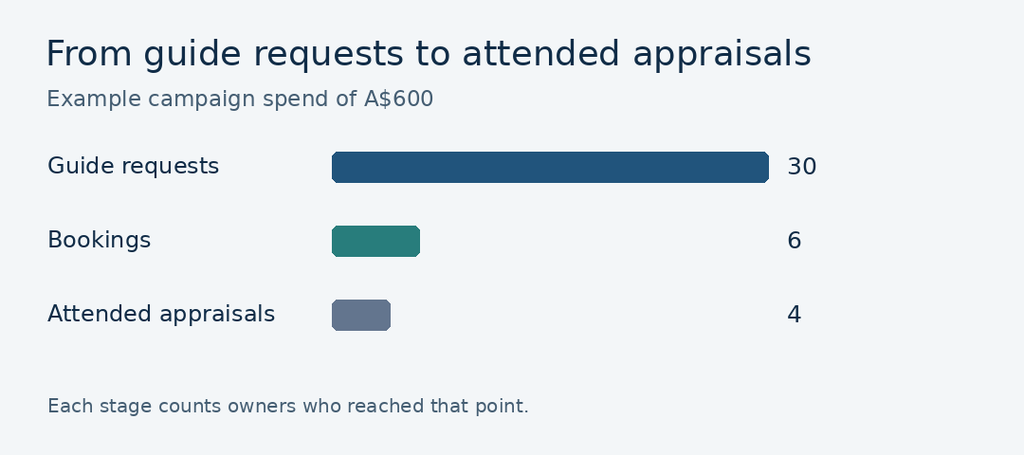
Suppose a campaign costs A$600 and attracts 30 guide requests. Six owners book an appraisal and four attend. That works out to A$20 per request, A$100 per booking and A$150 per attended appraisal. These figures illustrate the calculation. Compare your own campaigns over a similar period and include the same costs in each.
If enquiries arrive but few people book, read the replies before changing the ad. Owners asking about a sale price may need a clearer comparison. If appointments are booked but missed, check that the confirmation includes the date, time, address and an easy way to reschedule.
Real Estate Marketing Australia worked example in Preston
Imagine you are the listing agent and have one afternoon to prepare a seller guide. Your starting material is a question from an open home. A neighbour has seen two nearby townhouses sell and wants to understand why the results differed. The following example uses a fictional campaign. Supply your own verified sales and obtain permission for any photography you use.
Selecting comparable sales for real estate marketing Australia-wide
Choose sales that an owner could reasonably compare with their home. If one has a separate driveway and the other shares access, say so. If you inspected only one of them, distinguish what you observed from what the published listing says. Record the source and date beside each fact. Leave an unknown field blank and tell the reader what you would check during a visit.
Build the guide around one side-by-side comparison. Give each property a column and use the same rows for bedrooms, internal area, outdoor space, parking, condition and sale date. End with two sentences that explain why the comparison is useful and one question it leaves open. An owner should be able to use the guide at the dinner table without having to decode an agent’s spreadsheet.
Write the landing page from the owner’s perspective
A landing page might open with “What can two recent Preston townhouse sales tell you about yours?” Follow with a preview such as “See how parking, outdoor space and condition change the comparison.” Include a sample row from the guide. That gives the visitor a reason to share an email address and a way to judge whether the guide suits their property.
Give the button a label that describes what happens next. “Email me the Preston comparison” is precise. On the confirmation screen, say who the email will come from and what to do if it does not arrive. Include a way to contact the agent if the visitor would prefer to ask a question over the phone. Walk through both routes before you share the page.
Turn one comparison into three distinct posts
For a short video, stand beside a feature you have permission to film and explain one observation in everyday language. For a carousel, put the seller’s question on the first slide, the comparison in the middle and the link to the full guide on the last. For an email to people who requested local updates, lead with a finding and invite readers to reply with a question.
Keep a note of the promise each version makes. If the video is about parking and the landing page opens with school catchments, visitors have to work to find what they came for. A simple test is to show someone the post, hide it and ask what they expect to see after tapping. If the answer surprises you, revise the page or the post before spending money.
Real Estate Marketing Australia follow-up scripts
The most valuable field in your enquiry record can be the owner’s own question. Save it alongside the suburb and the preferred contact method. A colleague picking up the conversation after a busy Saturday should be able to answer without asking the owner to repeat the story. Use these examples as starting points and adapt them to what the person actually said.
When the owner is researching a future sale
“You mentioned you might move next year. The comparison on the second page is closest to the home you described because both have a courtyard and a single garage. Would it help if I explained which differences I would look at on a visit?” This response delivers something specific even if the owner has no intention of booking an appointment this month.
If the owner says they are gathering information, note that in the record. Ask whether they would like another comparison when a similar home sells. If they do, agree on the type of property and preferred channel. A relevant future sale gives you a genuine reason to reconnect and gives the owner control over the timing.
When the owner asks what their home is worth
“Thanks for telling me about the extension. I haven’t seen the layout, so I’d like to check how the extra room connects to the living area before choosing comparable sales. Would you prefer a short call first or a visit on Thursday?” Explain what you still need to know and why it matters. That makes the invitation easier to evaluate.
In the booking confirmation, name the person attending, give an approximate duration and explain what the owner will receive afterwards. If the owner wants a partner or co-owner present, offer a time that works for both. Record any access instructions in the appointment details so the agent arrives prepared.
When the enquiry is from a buyer
A buyer downloading a comparison may be preparing for an auction. Ask which property caught their attention and whether they have a question about the advertised home. Route the enquiry to the person handling that listing. If the buyer also has a property to sell, ask which conversation they would like to have first, then record the agreed next step.
This distinction matters when you review results. Ten buyer questions can be valuable to a sales campaign while producing zero seller appraisal requests. Keep a buyer category in the report so the advertising team can see whether the wording attracted the intended audience. A photo of a home for sale can easily overshadow a caption aimed at its neighbours.
Real Estate Marketing Australia four-week review
In week one, choose the seller question, prepare the guide and assign a person to answer replies. Write down what counts as an enquiry, a booked appraisal and an attended appraisal before the campaign starts. If two agents share a mailbox, decide who owns each suburb and who covers it when the assigned agent is at an inspection.
In week two, share the guide through one channel where you already speak with local owners. Use a distinct link for each placement. A QR code on an open-home handout and a link in an email can point to the same page with different campaign labels. Submit a test enquiry through both and check that the source carries through to the agent’s record.
In week three, read a handful of replies with the agent who handled them. What question keeps coming back? Is a photo too small on mobile? Did someone want the guide for a neighbouring suburb? Choose one change that answers a real objection and write down the date you made it. Give the revised version time to reach a comparable audience.
In week four, reconcile the campaign report with the appointment diary. Mark cancellations and reschedules separately. If one owner asked for the guide twice and booked once, keep both interactions under one owner record. Review the outcome with the agent before moving budget. A busy calendar can include appointments generated by referrals months before your campaign began.
Real Estate Marketing Australia channel comparison
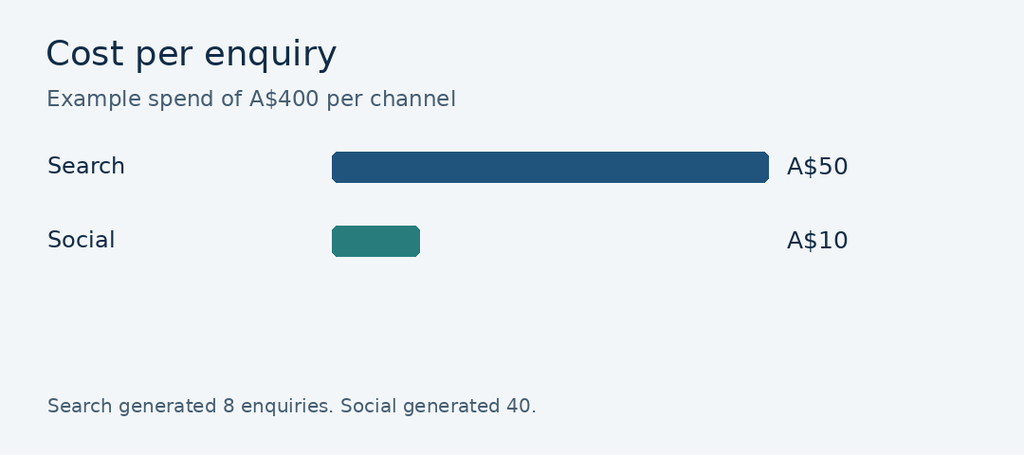
Consider two hypothetical campaigns that each cost A$400. Search produces eight enquiries and four attended appraisals. Social produces 40 enquiries and two attended appraisals. The enquiry costs are A$50 and A$10 respectively, while the costs per attended appraisal are A$100 and A$200. Which number you use changes how you interpret the campaign.
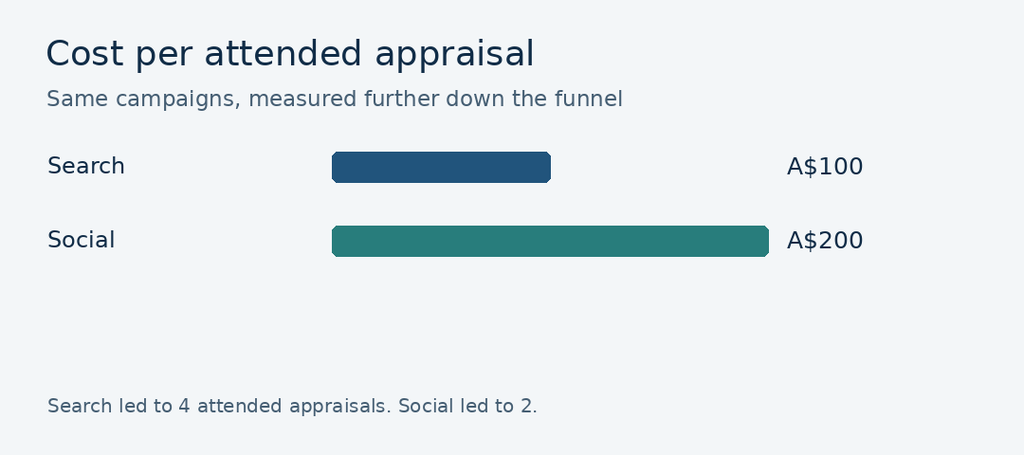
Before reallocating spend, look at the time since each enquiry came in. Owners who downloaded a guide last week have had less time to book than owners who requested an appraisal last month. Compare groups of similar age, and keep tracking listings won. With only a few appointments, a single reschedule can change the apparent winner.
Find the first point where owners drop out
If a page draws plenty of visits but few requests, check that the offer above the form matches the ad. If people request the guide but never open it, send a test to a mailbox outside the agency and inspect the subject line and delivery. If owners open the guide and reply but decline appraisals, ask the agent what they wanted instead.
Use those answers to choose one revision. For example, a homeowner who keeps asking about the age of the sales has identified a missing field in the comparison. Adding dates is a more direct fix than rewriting the headline. Keep a brief change log alongside the weekly figures so the team knows what it was testing when results moved.
Scaling real estate marketing Australia-wide
Look for a repeatable process before scaling. Can another agent prepare the comparison, explain its limitations and pick up a reply using the existing notes? Is there enough local evidence for a second guide? Do you know who will answer when a seller requests an appraisal? If any of those answers are unclear, use another week to resolve the gap.
When you expand, build the new guide from that suburb’s questions and transactions. Keep the same reporting definitions so the campaigns can be compared. Give the new area its own contact person, examples and review date. Two pages that differ only by suburb name give owners little reason to trust the advice or to return when they are ready to sell.
Real Estate Marketing Australia checklist for your first campaign
Pick one seller question from last Saturday, fill in the template and send yourself through the funnel before sharing it. After the first five enquiries, sit down with the agent who answered them. Their notes will tell you which part to improve next. For help connecting campaign enquiries to follow-up, explore Infinoq’s lead generation services.